
Helping Flood Stricken Rochester

From different directions fourteen RCBN members or relatives arrived at the Oppy statue in the main street of Rochester at 10:30 am and waited with apprehension. The town looked to be in immaculate condition, well kept, verdant gardens and nature strips and abundant foliage on the surrounding trees.
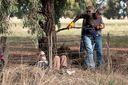
What was to be done? Finally we were met by the Rochester RC contact Graeme Nelson and after much chit chatting we followed him to the north-east along roads of diminishing quality until we arrived at a long, long driveway. The countryside was flat and first impressions were of great peace and tranquillity. We were directed to a fence, goodness knows how long, which in parts had been bowled over and in other parts the remnants of a tall crop were banked, thickly in places, almost to the top of the fence. Robin S volunteered to test the electrified wire and sure enough it was live.
The party then foraged around for primitive tools and set to work as Graeme departed for town. There was appreciation for the beauty of the location and the weather but there was also some grumbling. President Ross, realising the potential for mutiny, roused the gang by encouraging Negro Spirituals, first verses only of course because Phil M was there, and soon kilometre after kilometre of fencing was dutifully cleared. At high noon, with our starting point a distant spot on the horizon, Ian and Jill offered to go back to bring in the lunch orders and two hours later and a further five kms of cleared fencing they returned with sandwiches, cakes, water and wine. An hour later the delightful lady of the farm arrived with tea/coffee biscuits and cake; forty-five minutes after that a second afternoon tea arrived with cupcakes and then, as the distant town clock silently chimed 3:30, more tea and coffee and fresh, warm scones with jam and cream were produced. A sumptuous spread indeed.
By this stage the group had cleared every fence in sight and had begun to barehandedly roll up enormous lengths of barbed wire. But as the sun was setting the fourteen, like two rows of the seven dwarfs, cheerfully trudged back to Rochie singing, “Hi, ho, hi, ho it’s to the pub we go....”
The entire club was there – all nine of them, and for the RCBN it was a revelation. Nine people, along with similarly low numbers in APEX and LIONS are trying to restore the town and the town’s spirit after the highest floods in history. Fifty families have still not returned to their homes, people are still fighting insurance companies, people have other families living with them in their houses, some folk, such as the caravan park owner on the banks of the Campaspe River, have lost their livelihood. And there is still work to be done and people who need real care for depression. They are clearly a wonderful example of Rotarians putting service before self, time after time. The next morning, after a hearty breakfast, we were summoned to court. Many of our group had admired this old building from a distance as we waited on Saturday morning not thinking that we might spend some hours working there.
The building had been flooded and the carpet and masonite covering over the original floor boards had been removed leaving hundreds of nails. We set about, with modern tools, to remove all the protruding nails, tidy up, clean the toilet (not like the ones at home!) and in the end the difference was enormous. It is a wonderful building that is to be fully restored and we have helped greatly. Interestingly some time ago the building began to crack due to the drought, quite sizeable cracks are evident, and the locals had sunk big pipes into the ground in an attempt to return moisture to the shrinking clay base. Was it a successful venture? Was it worthwhile? I believe yes on both counts. It is true that the fence clearing we did was modest, almost insignificant, given the hundreds of kilometres of fencing still clogged up but one farmer now has a great start to help him and so often it is the start which is daunting.
The courthouse job was a much simpler task and will help a great deal in the restoration project even though that may well be quite some time before completion. But the biggest success was support for and fellowship with nine Rotarians who are working their hearts out.
Thanks to all who attended and especially for Sue Jones who spotted the need and did the organisation.
Download the website sponsorship guide